
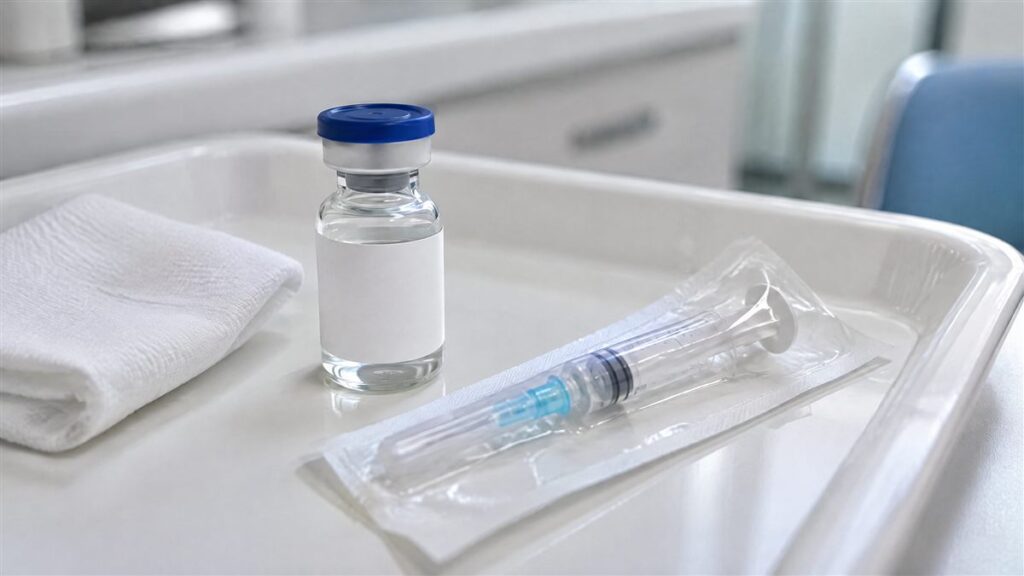
The side effects listed on a vitamin B12 injection label, what the label does not say, and when to call your provider.
The B12 injection label lists mild temporary diarrhea, itching and a skin rash as the milder side effects, and rare serious ones including allergic reactions. The label does not say how often any side effect happens. This guide goes through what the label lists, what it leaves out, and what to ask your provider before an injection.
This article is general information, not medical advice or a dose recommendation. Your prescribing provider decides whether B12 injections are right for you.
What are the side effects of a B12 injection?
We read the prescribing information for a cyanocobalamin injection on DailyMed, the U.S. National Library of Medicine’s label database (DailyMed). Cyanocobalamin is one form of vitamin B12. The label groups the reported adverse reactions by body system, and it does not give percentages. Here is what it lists:
| Body system | What the label lists |
|---|---|
| Whole body | Anaphylactic shock and death have been reported with injected vitamin B12 |
| Heart and circulation | Pulmonary edema (fluid in the lungs) and congestive heart failure early in treatment; peripheral vascular thrombosis (a blood clot in a limb) |
| Blood | Polycythemia vera (too many red blood cells) |
| Stomach and bowel | Mild transient diarrhea |
| Skin | Itching; transitory exanthema (a short-lived rash) |
| Other | A feeling of swelling of the entire body |
Source: DailyMed, cyanocobalamin injection label, Adverse Reactions section. The label lists these as reported reactions. It does not say how common they are or prove each was caused by the drug.
The label gives no rate for any of these, so we cannot say how likely they are. We list the serious ones because you should know what to look out for.
What does the label warn about?
The same label has a warnings section. In plain terms it says (DailyMed):
- Do not use it if you are sensitive to cobalt or vitamin B12. This is listed as a contraindication, meaning a reason not to use the product.
- Allergic reactions can be severe. Anaphylactic shock and death have been reported after injected B12, and the label suggests a test dose for people suspected of being sensitive.
- Early Leber disease. People with this inherited optic nerve condition who were treated with cyanocobalamin suffered severe and swift optic atrophy, damage to the optic nerve.
- Very low potassium. Hypokalemia and sudden death may occur in severe megaloblastic anemia treated intensively.
- Ingredients. The product contains benzyl alcohol, which has been linked to a fatal “gasping syndrome” in premature infants, and aluminum, which may reach toxic levels with prolonged use if kidney function is impaired.
The label also says no overdosage has been reported. It does not say whether overdosing is impossible, so we will not claim that.
Why are B12 injections given at all?
The label says cyanocobalamin is indicated for vitamin B12 deficiency caused by malabsorption, meaning the body cannot take B12 in from food. Conditions it lists include pernicious anemia, stomach or bowel surgery, and certain bowel diseases. MedlinePlus says deficiency is most common in people over 50, people who follow a vegetarian or vegan diet, people who have had stomach or intestinal surgery such as weight loss surgery, and people with digestive conditions such as celiac or Crohn disease (MedlinePlus).
That matters for side effects, because the label describes use in people with a diagnosed deficiency. We did not find a source that measures side effects in people who get B12 injections for general wellness. For what people commonly use B12 shots for, see our guide to B12 shots: benefits and how soon you feel them.
Is the label the same for every B12 injection?
No. The label we read covers cyanocobalamin made by one manufacturer. Other forms of B12, such as methylcobalamin, and compounded B12 prepared by a pharmacy have their own ingredients and no FDA-approved label. The FDA says it does not verify the safety, effectiveness or quality of compounded drugs before they are marketed (FDA). So the label is a good guide to what B12 injections can do, not a measurement of any particular product.
What should you ask your provider?
- Which form of B12 am I getting, and why?
- Do I have a reason not to have it? Tell them about any allergies, especially to cobalt or B12, any eye or optic nerve condition, kidney problems, and heart or blood conditions.
- What happens right after the injection? Ask whether you should stay in the clinic for a short time.
- What symptoms mean I should get urgent care?
- Who do I contact between visits?
If you are curious about the injection itself, our guide to B12 injections at home covers what to ask, and our page on B12 injections in Miami covers the clinic service.
When should you call your provider or get urgent care?
Call 911 or go to the nearest emergency department if you have trouble breathing, swelling of the face, lips or throat, hives all over, or feel faint after an injection. These can be signs of anaphylaxis. Call your provider if you have itching or a rash that does not go away, diarrhea that lasts, or swelling in a leg, shortness of breath or chest pain. Anyone can also report a side effect to the FDA through MedWatch.
Frequently asked questions
What are the side effects of a B12 injection?
The cyanocobalamin injection label lists mild temporary diarrhea, itching and a temporary skin rash as the milder effects. It also lists rare but serious ones: allergic reactions including anaphylaxis, fluid in the lungs and heart failure early in treatment, and blood clots in the veins and arteries. The label does not give how often any of them happen.
How long do B12 injection side effects last?
The label does not give a length for any side effect, and we did not find a source that does. It describes the diarrhea as mild and transient, meaning short-lived. Tell your provider if anything lasts or worries you.
Can a B12 injection cause an allergic reaction?
Yes. The label says anaphylactic shock and death have been reported after injected vitamin B12, and it lists sensitivity to cobalt or vitamin B12 as a reason not to use it. Anaphylaxis is an emergency, so call 911 if you have trouble breathing, swelling of the face or throat, or feel faint after an injection.
Is it possible to get too much B12 from injections?
The label says no overdosage has been reported with the product. That is not the same as saying nothing can go wrong, and the label lists other warnings. Your provider decides whether injections suit you and how often.
Who should not have a B12 injection without talking to a doctor first?
The label says to avoid it if you are sensitive to cobalt or vitamin B12, and it warns about people with early Leber disease, an inherited eye condition, who suffered rapid optic nerve damage after treatment. It also warns that very low potassium can occur when severe B12-deficiency anemia is treated intensively. Tell your provider your full history before an injection.
Are side effects the same for methylcobalamin or compounded B12?
We cannot say. The label we read is for cyanocobalamin, one form of B12. Compounded products are not FDA-approved, and the FDA says it does not verify the safety, effectiveness or quality of compounded drugs before they are marketed. Ask your provider which form you are getting.
Next step
If you live in Miami and want a physician to review whether B12 injections suit your health history, start the free intake form. A physician reviews it, and the team contacts you to schedule your free appointment. You can also read our guide to getting B12 shots in Miami. The clinic is at 917 SW 87th Ave, Miami, FL 33174, and you can call (786) 724-1199 if you would rather talk it through first.
Sources
- DailyMed, cyanocobalamin injection prescribing information (Adverse Reactions, Warnings, Contraindications, Indications, Overdosage): dailymed.nlm.nih.gov.
- MedlinePlus, Vitamin B12 (U.S. National Library of Medicine): medlineplus.gov.
- FDA, Compounding and the FDA: Questions and Answers: fda.gov.